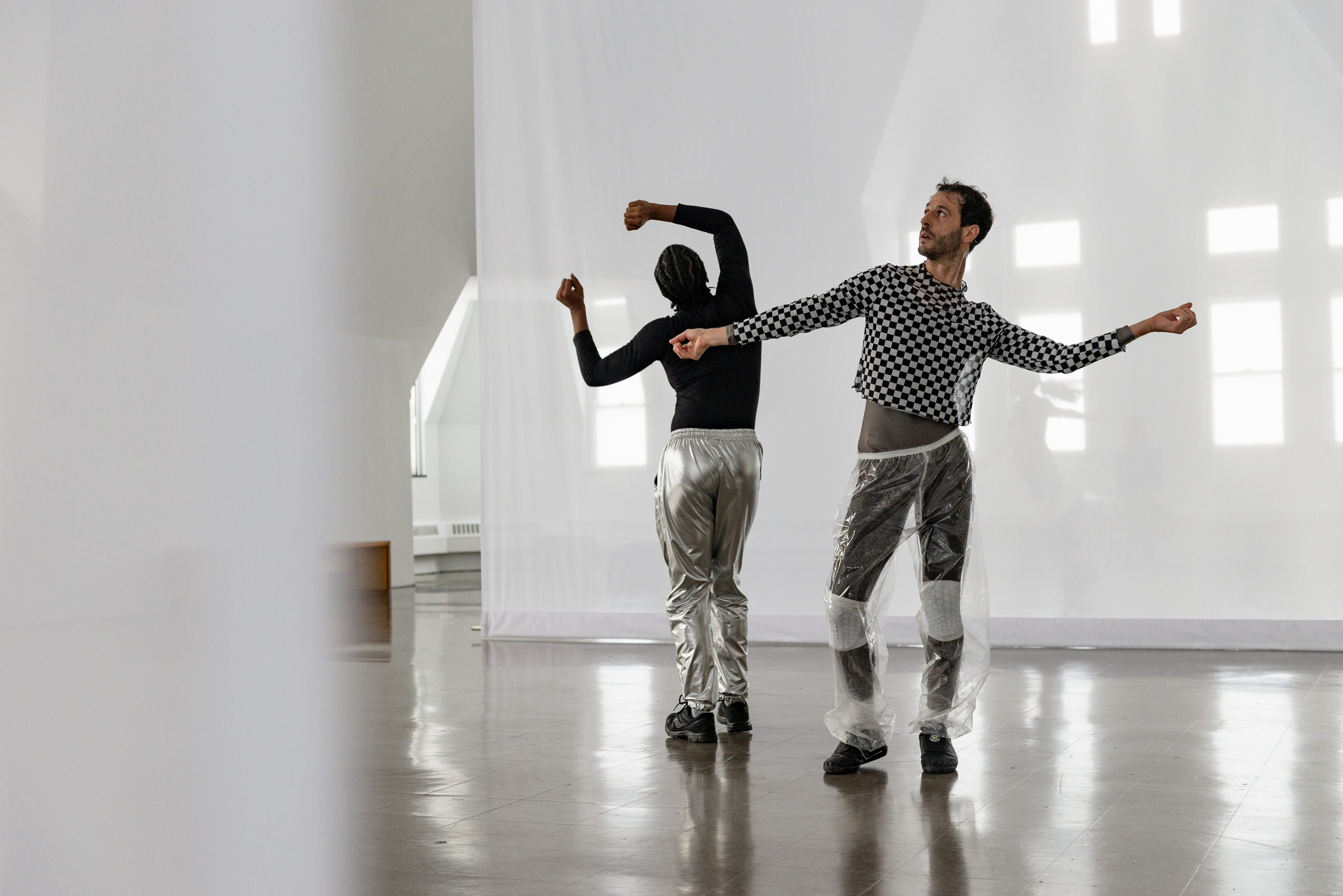
Moriah Evans, Scrimmage, 2025, December 7 performance. Pictured: Kris Lee, João dos Santos Martins. Photo by Ry Thiel.
Moriah Evans, Scrimmage, 2025, December 7 performance. Pictured: Kris Lee, João dos Santos Martins. Photo by Ry Thiel.

Moriah Evans, Scrimmage, 2025, December 7 performance. Photo by Ry Thiel.

Moriah Evans, Scrimmage, 2025, December 7 performance. Pictured: Kris Lee, Lizzie Feidelson. Photo by Ry Thiel.

Moriah Evans, Scrimmage, 2025, December 7 performance. Pictured: Varinia Canto Vila. Photo by Ry Thiel.

Moriah Evans, Scrimmage, 2025, December 7 performance. Pictured: Lizzie Feidelson, Kris Lee. Photo by Ry Thiel.

Moriah Evans, Scrimmage, 2025, December 7 performance. Pictured: João dos Santos Martins, Kris Lee, Varinia Canto Vila. Photo by Ry Thiel.

Moriah Evans, Scrimmage, 2025, December 7 performance. Pictured: João dos Santos Martins, Kris Lee. Photo by Ry Thiel.

Moriah Evans, Scrimmage, 2025, December 7 performance. Pictured: Lizzie Feidelson, João dos Santos Martins, Kris Lee. Photo by Ry Thiel.

Moriah Evans, Scrimmage, 2025, December 14 performance. Pictured: Varinia Canto Vila, Lizzie Feidelson, Kris Lee, João dos Santos Martins. Photo by Ry Thiel.

Moriah Evans, Scrimmage, 2025, December 7 performance. Pictured: João dos Santos Martins, Kris Lee, Lizzie Feidelson. Photo by Ry Thiel.

Moriah Evans, Scrimmage, 2025, December 7 performance. Pictured: Lizzie Feidelson. Photo by Ry Thiel.

Moriah Evans, Scrimmage, 2025, December 7 performance. Pictured: Varinia Canto Vila, Kris Lee, Lizzie Feidelson. Photo by Ry Thiel.

Moriah Evans, Scrimmage, 2025, December 7 performance. Pictured: João dos Santos Martins. Photo by Ry Thiel.

Moriah Evans, Scrimmage, 2025, December 7 performance. Pictured: João dos Santos Martins. Photo by Ry Thiel.

Moriah Evans, Scrimmage, 2025, December 7 performance. Pictured: Pierre Sondeijker, Eleonore Zurawski. Photo by Ry Thiel.

Moriah Evans, Scrimmage, 2025, December 14 performance. Pictured: Eleonore Zurawski. Photo by Ry Thiel.

Moriah Evans, Scrimmage, 2025, December 7 performance. Pictured: Kris Lee, João dos Santos Martins. Photo: Ry Thiel.

Moriah Evans, Scrimmage, 2025, December 14 performance. Pictured: João dos Santos Martins. Photo by Ry Thiel.

Moriah Evans, Scrimmage, 2025, December 14 performance. Pictured: Varinia Canto Vila, Lizzie Feidelson, Kris Lee, João dos Santos Martins. Photo by Ry Thiel.

Moriah Evans, Scrimmage, 2025, December 14 performance. Pictured: Varinia Canto Vila, Lizzie Feidelson, Kris Lee. Photo by Ry Thiel.

Moriah Evans, Scrimmage, 2025, December 14 performance. Pictured: Varinia Canto Vila, Lizzie Feidelson, Kris Lee, João dos Santos Martins. Photo by Ry Thiel.

Moriah Evans, Scrimmage, 2025, December 14 performance. Pictured: João dos Santos Martins, Kris Lee. Photo by Ry Thiel.

Moriah Evans, Scrimmage, 2025, December 14 performance. Pictured: Varinia Canto Vila. Photo by Ry Thiel.

Moriah Evans, Scrimmage, 2025, December 14 performance. Pictured: Lizzie Feidelson, Kris Lee. Photo by Ry Thiel.

Moriah Evans, Scrimmage, 2025, December 14 performance. Pictured: Varinia Canto Vila, Kris Lee, João dos Santos Martins, Lizzie Feidelson. Photo by Ry Thiel.

Moriah Evans, Scrimmage, 2025, December 14 performance. Pictured: Lizzie Feidelson. Photo by Ry Thiel.

Moriah Evans, Scrimmage, 2025, December 14 performance. Pictured: Varinia Canto Vila, João dos Santos Martins. Photo by Ry Thiel.

Moriah Evans, Scrimmage, 2025, December 14 performance. Pictured: Kris Lee, João dos Santos Martins, Lizzie Feidelson. Photo by Ry Thiel.

Moriah Evans, Scrimmage, 2025, December 14 performance. Pictured: Lizzie Feidelson, Kris Lee. Photo by Ry Thiel.

Moriah Evans, Scrimmage, 2025, December 14 performance. Pictured: Varinia Canto Vila, João dos Santos Martins, Kris Lee, Lizzie Feidelson. Photo by Ry Thiel.

Moriah Evans, Scrimmage, 2025, December 14 performance. Pictured: Varinia Canto Vila, João dos Santos Martins, Kris Lee, Lizzie Feidelson. Photo by Ry Thiel.

Moriah Evans, Scrimmage, 2025, December 14 performance. Pictured: Lizzie Feidelson, Kris Lee. Photo by Ry Thiel.

Moriah Evans, Scrimmage, 2025, December 14 performance. Pictured: Lizzie Feidelson, Kris Lee. Photo by Ry Thiel.
PERFORMANCES
SAT, DEC 6: 1-5PM
SUN, DEC 7: 1-5PM
SAT, DEC 13: 2-4PM
SUN, DEC 14: 2-4PM
Moriah Evans, an artist and choreographer based in New York, creates innovative performances for a wide variety of contexts. Building on a series of projects that she has staged in different cities in recent years, Evans continues to explore how performance can offer different ways of sensing our bodies and our relationships to one another. Throughout her work, Evans approaches choreography as an expansive social process, drawing on wide-ranging somatic practices and feminist critiques of dance and visual culture, while seeking out the “knowledge our bodies hold.” She aims to heighten perception beyond the visual, embracing embodied forms of awareness and felt sense.
This winter, for an expanded edition of the Intermissions series, Evans spends two weeks at the Renaissance Society with a small ensemble of dancers. For this new project, Scrimmage, Evans stages a pattern of private rehearsals and public presentations that shifts during the span of her time in the gallery space. Each weekend, she offers a different format to visitors as she opens the doors to the public on Saturday and Sunday afternoons. The first two performances (December 6th and 7th) will have an open-ended durational form, fluid and still evolving in real-time. The later performances (December 13th and 14th) offer a concentrated version, staged as a more bounded event. Visitors are encouraged to come multiple times and experience both formats.
Through her scored performance structures and a set of scenographic interventions created specifically for this space, Evans invites an active state of perception—grounded in one’s body and attuned to a larger milieu and social infrastructures—along with hints of reverie where things do and don’t make sense. In the vaulted gallery, she is composing with both material and immaterial ingredients: hanging scrims, enveloping sound, dancers in motion and in stillness, lines of sight, textures of light, and a public that stays or passes through. Dance, here, is both fleeting and visceral, evoking bodies at once fragile and forceful. Evans aims to create a setting for Scrimmage that has a related set of wavering qualities: heavy and light, monumental and ethereal. In doing so, she considers the frame and the format in tandem, the contents of her work and its container, the body and what’s beyond it.
Within her choreographic scores, often developed collaboratively with her dancers, Evans draws on a variety of movement patterns and methods from different contexts. In doing so, she assembles them as a series of floating signifiers or somatic catalysts rather than explicit references. At times, the dancers work together or move apart, drawing out different internal and external states of being, variously individual and collective. Evans foregrounds the ways dance can create different kinds of sociality between people, running interference in the ways our relationships and social connections are mediated through technology, learned behavior, and language. For her this involves recognizing the multiplicity of things that make up a person, complete with inevitable dissonance or incoherence. Scrimmage negotiates how we are always deep within our bodies and also beyond them, constantly feeling and perceiving, figuring out ourselves and others, being affected by micro and macro forces and affecting them in turn.
Performers:
Lizzie Feidelson
Kris Lee
João dos Santos Martins
Varinia Canto Vila
Sound design:
Ian Douglas-Moore
Additional music:
David Watson
Costumes:
Strauss Bourque-La France
and Moriah Evans
Studio Management:
Margaret Knowles
Curated by Karsten Lund.
Launched in 2017, Intermissions is an ongoing programming series devoted to performance and other inventive time-based works, staged in the Renaissance Society’s empty gallery in between exhibitions. This recurring platform features two artists every year, supporting a wide variety of live projects.
Moriah Evans positions choreography as an expansive social process. Drawing on somatic choreographic practices and feminist critiques of dance and visual culture, her work expands dance beyond the visible, to explore different ways of sensing both ourselves and our relationships to one another. Evans develops movement from the unseen interior of the body, by activating the emotional, somatic, and sensory systems to question the default hierarchies between notions of flesh, body, self, and subject. For Evans, choreography is a social political project that means far more than arranging bodies and movement in space; it is a serious and wide-ranging exploration of ideological beliefs–including feminist, sociological, and anthropological considerations. In Evans’ practice, one work leads to the next, each project forming a chapter in her ongoing process to inspire transformation–both physically and psychosocially–through action.
Evans creates site-specific performances, theater-based productions, gallery and museum-based participatory installations, symposiums, theoretical texts, and curatorial projects. Recent works include: HARBORing (Snug Harbor Cultural Center and Botanic Garden, NY, 2025); BANKing (Musikinstallationen, Nuremberg, Germany, 2025); The Wait (New York Choreographic Institute, New York City Ballet, NY, 2024) Remains Persist (MOCA LA, CA, 2023; Performance Space New York, NY, 2022); Out of and Into: PLOT (Museion, Bolzano/Bozen, Italy, 2023); Rehearsals for Rehearsal (Public Art Fund, NY, 2022); RESTOS (Espacio Odeón, Bogotá, Colombia, 2021); REPOSE (Beach Sessions, NY, 2021); Be my Muse (Art Encounters Biennial, Timisoara, Romania, 2025; Pace Live, NY, 2021; Hirshhorn Museum, Washington DC, 2018; Villa Empain, 2016); BASTARDS: We are all Illegitimate Children (NYU Skirball, NY, 2019); Configure (The Kitchen, NY 2018); Figuring (Sculpture Center, NY, 2018).
Ian Douglas-Moore’s music uses guitar, electronics, and field recordings to explore the textures of resonant sounds as they engage with acoustic space. Treating an acoustic guitar as a tone generator, his recent improvisations with Eric Wong, Dominic Coles, Patrick Holmes, and others, blur the boundaries between electronic and acoustic music. His project with Aaron Snyder, Church Car, traverses minimalist psychedelic rock, text-sound composition, and music from imagined microtonal folk traditions. These musical experiences inform his sound design for artists like Moriah Evans, Annie Dorsen, and Lauren Bakst. In 2024 he completed an MFA in Sonic Arts at Brooklyn College.
Lizzie Feidelson is a writer and performer. She has worked with Moriah Evans since 2015, performing in her NYC premieres at ISSUE Project Room, Danspace Project, SculptureCenter, The Kitchen, and Performance Space New York, as well as in Shanghai, Paris, Los Angeles and Berlin. Her essays and reporting have appeared in New York Magazine, The New York Times Magazine, and The New Yorker, among other places.
Kris Lee is a New York based dance artist, performer, and DJ. Most recently they have performed in works by Julie Tolentino, Kevin Beasley, Moriah Evans, Ishmael Houston-Jones, Ralph Lemon, Miguel Gutierrez, Andros Zins-Browne, Jonathan González, Okwui Okpokwasili, and Shamel Pitts (TRIBE). They were a recipient of a 2024 danceWEB scholarship at ImPulsTanz under the mentorship of Isabel Lewis. Kris has shown work at Judson Memorial Church as part of Black Aesthetics and Cathy Weis Projects’ Sundays on Broadway. In 2025, she had the pleasure to be part of OO-GA-LA, the re imagining of Fred Holland and Ishmael Houston-Jones’ 1983 Untitled Duet at Danspace Project. They received their BFA in Dance from University of the Arts in 2019.
João dos Santos Martins is an artist whose work encompasses dance, exploring formats such as choreography, exhibition, and publishing. His practice articulates collaborative ways of working that focus on issues of transmission, language and labor. Together with Ana Bigotte Vieira, they created a platform for mapping genealogies of dance history in Portugal (Para Uma Timeline a Haver). He founded a biannual journal — Coreia — dedicated to artists’ writings in 2019. João performed in works by Ana Rita Teodoro, Xavier Le Roy, Eszter Salamon, Boris Charmatz, Marcelo Evelin, Jérôme Bel, Rui Horta, among others. Occasionally he writes and curates. In 2014, he co-founded Parasita, an artists’ association based in Lisbon.
Varinia Canto Vila is a dancer, choreographer, and researcher based in Santiago since 2019. Recently, she has shifted focus from dance medium-based themes to the intersection of art and politics, employing extended choreography to examine movement within the social body. She created the performance piece Maneras de Salir (Ways to Exit), which explores the notions of distances and proximities between people and their socio-economic and political realities. In 2024, she created MUNDOS (Worlds), which revolves around the concept of a fragmented society. She has shown her work in Belgium, Poland, Germany, Argentina and Chile.
The development of this project is supported by Dance/NYC’s Dance Advancement Fund, made possible by the Howard Gilman Foundation and the Ford Foundation. This project has also been developed, in part, during a 2025-2027 Vera List Center Fellowship at The New School. It has been supported by the Vera List Center for Art and Politics. It was also developed with residency support from the Brooklyn Academy of Music (BAM).
Renaissance Society programs are supported by Teiger Foundation and The Andy Warhol Foundation for the Visual Arts.
Additional thanks to The Neighborhood Hotel.


